


How the floor system you choose quietly determines the success of your entire build
Floor truss vs I-joist: key differences in real builds
When someone looks at a set of plans for a new home, their attention usually goes to the visible things—the exterior, the layout, the kitchen, the windows. The floor system rarely gets a second thought. It’s just “framing,” right?
But from a builder’s perspective, the floor system is one of the most important decisions on the entire project. It affects how every trade works after framing is complete. It determines how cleanly mechanical systems are installed, how the structure performs over time, how the floor feels under your feet, and how many problems you’ll be solving later.
There are three primary options used in residential construction today: traditional dimensional lumber (like 2×10s), engineered I-joists, and open-web floor trusses. Each one can technically “work.” But they do not perform the same in real-world construction—and they definitely don’t create the same experience during the build. When deciding between a floor truss vs I-joist system, most people don’t realize how much the choice impacts the entire build process.
If you’re trying to make the right decision, the question isn’t just which one is structurally sufficient. The real question is: which system will give you the fewest problems, the best long-term performance, and the most efficient build process?
The legacy option: traditional 2×10 floor joists
For decades, dimensional lumber was the default. Builders framed floors with 2×10s or 2×12s, spaced them out, nailed everything together, and moved on. It worked, and in simple applications, it still can.
But the industry has changed. Homes are larger. Mechanical systems are more complex. Expectations are higher. And the limitations of dimensional lumber have become more obvious over time. In the floor truss vs I-joist decision, long-term performance and jobsite efficiency often matter more than material cost.
The biggest issue isn’t that 2×10s can’t hold the load—they can, within their limits. The problem is everything else that comes with them. Wood is a natural material. It twists, crowns, shrinks, and varies from piece to piece. That means you don’t get consistency.
One joist might be perfectly straight, while the next one has a slight bow. Over a full floor system, those small inconsistencies stack up.
This is where you start to see uneven floors, squeaks, and the subtle imperfections that homeowners notice later but can’t quite explain.
Then there’s the issue of mechanicals. Modern homes require extensive plumbing, electrical, and HVAC routing. With 2×10s, every pipe or wire that needs to pass through the joist requires drilling or notching—and that introduces both labor and risk. If it’s done incorrectly, it can compromise the structural integrity of the joist. Even when it’s done correctly, it slows everything down and creates coordination challenges between trades.
From a contractor’s perspective, this is where projects start to lose efficiency. The framing might go in quickly, but everything that follows becomes more complicated.
That’s why, while 2×10 framing still shows up in smaller or simpler builds, it’s no longer the go-to solution for projects where performance and coordination matter.
The modern standard: engineered I-joists
Engineered I-joists were introduced to solve many of the problems that come with dimensional lumber. Instead of relying on natural wood variability, they’re manufactured to be straight, consistent, and predictable.
That alone changes a lot.
When you install I-joists, you’re working with a product that doesn’t warp or twist the way traditional lumber does. Floors come out flatter. The structure behaves more predictably. You eliminate a lot of the small issues that turn into bigger problems later.
From a span perspective, I-joists also outperform traditional lumber. They can cover longer distances with less material, which allows for more open layouts and fewer beams or
supports. That flexibility is one of the reasons they’ve become so common in residential construction.
But where I-joists start to show limitations is in coordination with mechanical systems.
Unlike open-web trusses, I-joists have a solid web (usually OSB), and while you can cut holes in that web, there are strict rules about where and how those holes can be placed. The size, location, and spacing of openings all have to follow manufacturer guidelines.
In theory, this is manageable. In practice, it requires planning—and that’s where things can break down.
If the mechanical layout isn’t coordinated early, trades end up working around the structure instead of through it. That leads to rerouting, tight spaces, and sometimes field modifications that weren’t part of the original plan. It’s not uncommon to see situations where HVAC ducts have to be squeezed into smaller cavities or where plumbing runs take longer paths than necessary.
None of this makes I-joists a bad system. In fact, when they’re designed and coordinated properly, they perform very well. They strike a balance between cost, performance, and availability that works for a wide range of projects.
But they do require discipline in the design phase. If that discipline isn’t there, the advantages start to erode.
You can see a real example of this in a custom home we built using floor joists
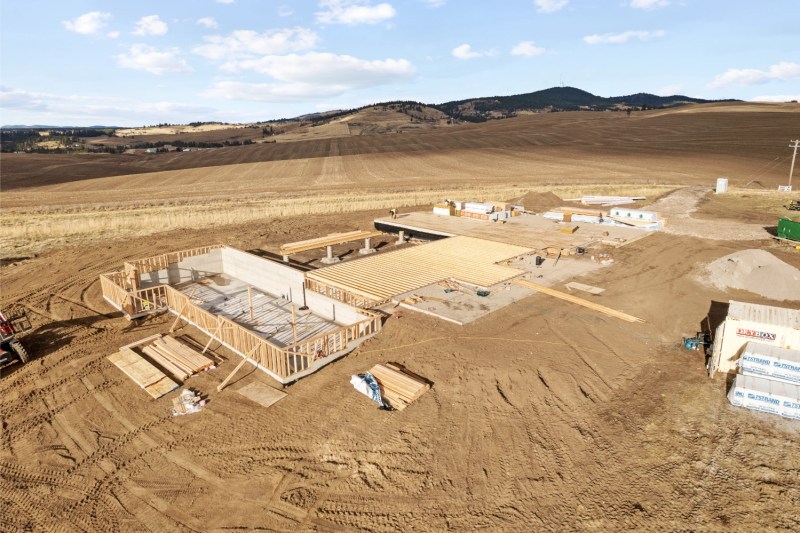
The high-performance option: floor trusses
Floor trusses take a different approach altogether. Instead of a solid web, they use an open-web design made up of interconnected members. Visually, they resemble roof trusses laid horizontally.
That open-web design changes everything.
The biggest advantage is mechanical freedom. Instead of drilling holes or working around solid material, trades can run pipes, ducts, and wiring directly through the open spaces in the truss. There’s no guesswork, no risk of compromising structural members, and far less need for coordination gymnastics.
From a construction standpoint, this simplifies the entire process. Plumbers don’t have to worry about where they can drill. HVAC installers don’t have to reduce duct sizes to fit tight spaces. Electricians can run their lines cleanly without weaving through obstacles.
That alone can save significant time and reduce errors during the build.
Floor trusses also perform exceptionally well structurally. They’re engineered for specific loads and spans, which means they can cover long distances while maintaining stiffness. That translates into floors that feel solid underfoot, with less bounce and deflection.
For homeowners, this is one of those intangible qualities that makes a house feel “well built.” You might not know why the floor feels better—but you notice it.
Another advantage is design flexibility. Because trusses can be customized, they allow for features like dropped ceilings, integrated chases, and complex layouts without requiring major structural compromises.
So why doesn’t everyone use them?
The main trade-offs are cost and lead time. Floor trusses are typically more expensive upfront than I-joists, and they require engineering and fabrication before they arrive on site. That means you need to plan earlier and commit to your design sooner.
For builders who are working on tight schedules or trying to minimize upfront costs, that can be a barrier.
But when you look at the full picture—including labor efficiency, reduced rework, and long term performance—the value often becomes clear.
You can see a real example of this in a custom home we built using floor trusses.

The hidden cost of choosing the wrong system
One of the biggest mistakes people make when comparing floor systems is focusing only on the material price. On paper, traditional 2×10 framing often looks like the cheapest option. But once you’re actually building, the hidden costs start stacking up quickly.
The first issue shows up immediately during framing: getting the floor level.
Dimensional lumber isn’t perfectly consistent. Even good material will have slight crowns, bows, and variations from piece to piece. That means framers spend extra time sorting,
shimming, and adjusting joists just to get the floor reasonably flat. It’s not unusual for crews to burn a noticeable amount of labor just trying to make the structure acceptable before moving on.
And even after that effort, the floor often isn’t perfect.
That leads directly into the next trade—flooring.
Whether it’s LVP, hardwood, or tile, most finish flooring systems have strict flatness tolerances. If the framing isn’t within spec, the flooring contractor has to correct it. That usually means grinding high spots, filling low areas, or applying self-leveling compounds. All of that adds cost, time, and another layer of work that wouldn’t be necessary with a more consistent floor system.
Then there’s the issue of mechanical routing—which is where costs can really start to snowball.
Both traditional 2×10 joists and engineered I-joists have limitations on how much they can be drilled or notched. There are strict rules for hole sizes and locations, and for good reason—you’re cutting into structural members.
Because of those limitations, it’s very common for mechanical systems—especially HVAC ducts and larger plumbing lines—to be routed below the joists instead of through them.
Once that happens, you’ve created a new problem: now you have to hide those systems.
The solution is what’s commonly called a dropped soffit or ceiling drop. This is additional framing built below the joists to enclose ducts, pipes, or wiring runs. It adds material, labor, and coordination—and it doesn’t stop there.
You also lose ceiling height.
In areas where soffits are required, the finished ceiling is lower than originally intended. In some layouts, this can affect entire rooms or force design compromises just to accommodate mechanical runs.
By the time you account for:
• extra framing labor to level the floor
• additional prep work by flooring contractors
• soffit framing and finishing
• and the impact on ceiling height and design
…the “cheapest” floor system often isn’t the cheapest anymore.
This is where systems like floor trusses start to separate themselves. Because mechanicals can run directly through the structure, you eliminate the need for most soffits altogether. Floors come out flatter from the start, which reduces prep work downstream. And the entire build process becomes more efficient because trades aren’t working around structural limitations.
How floor systems affect every trade on the job
It’s easy to think of the floor system as a structural decision, but in reality, it’s an operational one.
Framing is just the first step. After that, multiple trades rely on the structure to do their work efficiently. When the structure works against them, everything slows down.
Plumbers need space to run drain lines with proper slope. HVAC installers need room for ducts without excessive turns or reductions. Electricians need clear paths for wiring. When those needs aren’t met, each trade has to adapt—and adaptation takes time.
This is where open-web trusses stand out. They don’t just support the structure—they support the workflow of the entire project.
I-joists can also work well in this context, but only if the design accounts for mechanical needs early on. Without that planning, they become a constraint rather than a solution.
Traditional lumber, in today’s construction environment, tends to create the most friction. It requires the most field modification and offers the least flexibility for modern systems.
Performance over time: what happens after the build
The impact of your floor system doesn’t end when construction is complete.
Over time, homeowners experience the results in subtle ways. Floors that feel solid versus floors that feel bouncy. Quiet floors versus squeaky ones. Smooth finishes versus minor imperfections that show up under certain lighting conditions.
Engineered systems—both I-joists and trusses—tend to perform better in this regard because they’re designed for consistency. They don’t rely on the natural variability of lumber, and they’re less prone to movement over time.
Traditional lumber, while still structurally sound when installed correctly, is more susceptible to changes due to moisture, temperature, and natural settling.
These differences might not be obvious on day one, but they become more noticeable as the home ages.
Choosing the right system for your project
There isn’t a one-size-fits-all answer. The right choice depends on the type of project, the level of complexity, and your priorities.
If you’re building a custom home with complex mechanical systems and a focus on long term performance, floor trusses are often the best choice. They provide the flexibility and reliability needed to execute a high-quality build.
If you’re working on a standard residential project and want a balance between cost and performance, engineered I-joists are a strong option—provided the design is coordinated properly.
If the project is simple, spans are short, and budget is the primary concern, traditional 2×10 framing can still be a viable solution. But it comes with trade-offs that should be understood upfront.
For more technical information on engineered wood systems, you can refer to the APA – The Engineered Wood Association.
Why this decision matters more than most
In construction, some decisions are visible and easy to change. Others are hidden and difficult to fix once they’re in place.
The floor system falls into the second category.
Once it’s installed, everything else builds on top of it—literally. If there are issues, they don’t stay isolated. They affect multiple trades, multiple stages of the build, and ultimately the final product.
That’s why experienced builders put so much thought into this decision. It’s not just about meeting code requirements or hitting a budget number. It’s about setting the foundation for a smooth build and a high-performing structure.
Final perspective from the field
From a distance, all three systems—2×10s, I-joists, and floor trusses—can look similar on paper. They all support loads. They all pass inspections. They all get the job done.
But up close, in the day-to-day reality of construction, they create very different outcomes.
The best floor system isn’t just the one that holds the structure up. It’s the one that makes the entire project work better—from framing to finishes, from installation to long-term performance.
And in most cases, the more you prioritize coordination, efficiency, and quality, the more the decision starts to lean away from traditional methods and toward engineered solutions.
Ultimately, choosing between a floor truss vs I-joist system comes down to how smooth you want the entire build process to be.